Squat
Back squat
The foundational lower-body lift. Builds leg and glute strength and teaches you to brace under load.
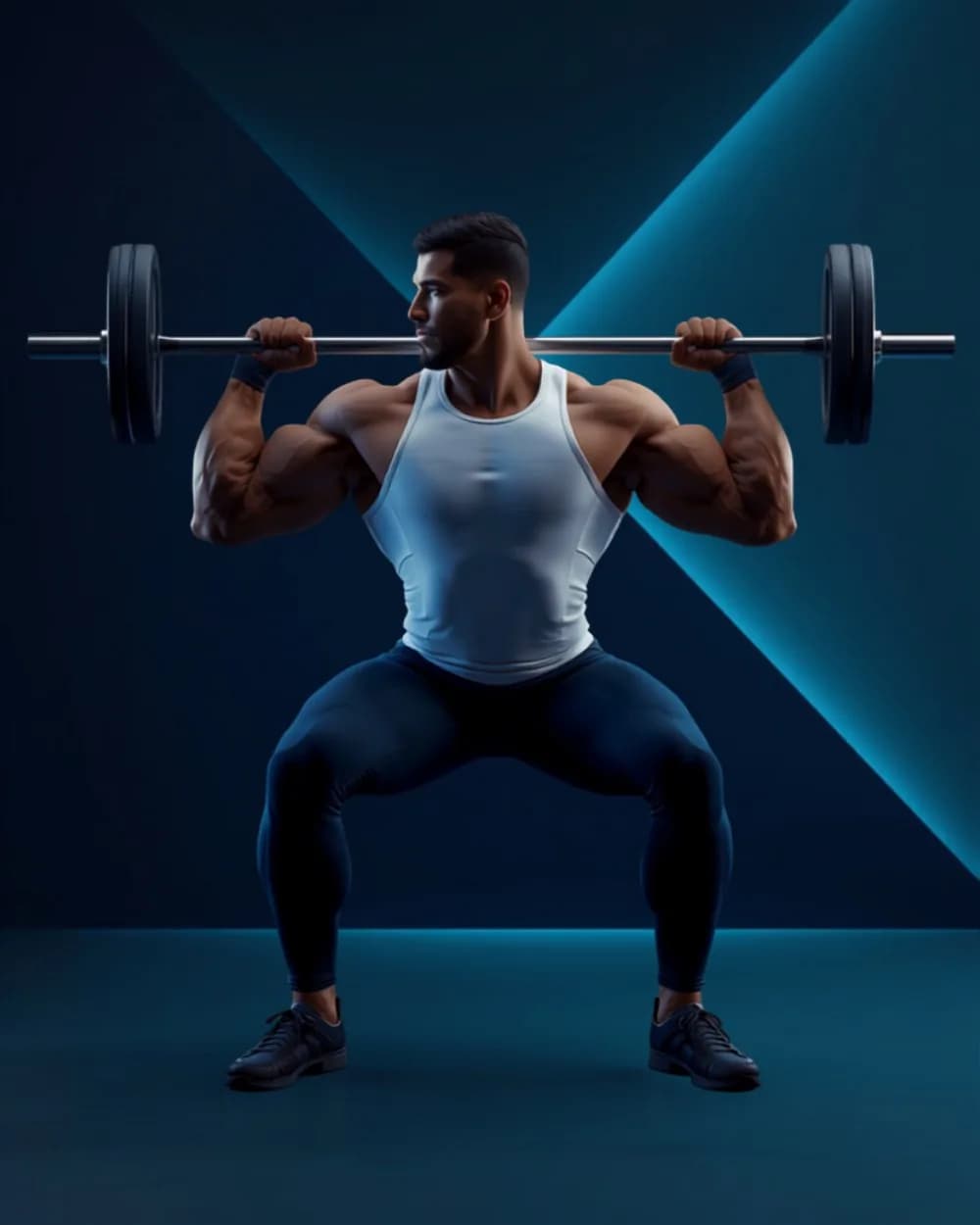
Squat · Intermediate
Back squat
Barbell · AI visualisation, illustrative only
- Equipment
- Barbell
- Level
- Intermediate
- Primary muscles
- Quadriceps, Gluteus maximus
- Secondary muscles
- Adductors, Spinal erectors, Abdominals
- Working range
- 4–8 reps · RIR 2
Step by step
- 1Set the bar in the rack at mid-chest height. Any higher and you will be on your toes to unrack it.
- 2Grip the bar wider than your shoulders, step under it and rest it on your traps — never on your neck.
- 3Pull your shoulder blades together, brace your abs as if about to take a punch, unrack and take two steps back.
- 4Feet hip-width or slightly wider, toes turned out a little, so your knees track over your feet.
- 5Take a breath, hold it, and descend by sending your hips back and bending your knees together.
- 6Go at least until your hips reach knee height — as far as your mobility allows.
- 7Drive back up through the floor, keeping your torso at the same angle as on the way down. Exhale only after clearing the hardest point.
What makes the biggest difference
- Brace before you unrack, not after.
- Keep pressure spread across the whole foot — heel and base of the big toe stay down.
- Head in line with the spine: look ahead, not at the ceiling.
Common mistakes
Knees cave inward on the way up
Think about spreading the floor apart with your feet. If that does not fix it, the weight is too heavy — drop 10-15% and rebuild the pattern.
Lower back rounds at the bottom
Usually limited ankle or hip mobility, not a weak back. Stop at the depth where your back stays flat and work on range separately.
Hips shoot up faster than the chest
The squat turns into a good morning with the bar on your back. Start the ascent thinking "chest up", not "hips up".
Bouncing out of the bottom
Bouncing shifts load onto the knee ligaments. Take two seconds down and pause briefly at the bottom.
What to do instead
Lower back pain
The back support removes axial load from the spine while the legs still work through full range.
Shoulder pain prevents holding the bar
Bulgarian split squat with dumbbells →
Dumbbells held at your sides need no shoulder external rotation, and single-leg work lets you use far less load.
No squat rack available
Goblet squat
A dumbbell held at the chest can be picked up off the floor, and it forces a more upright torso as a bonus.
Contraindications
- A recent knee or hip injury — clear your return with a physiotherapist before getting back under the bar.
- Uncontrolled hypertension — holding your breath under load raises arterial pressure.
- An acute disc herniation — avoid axial loading until a doctor clears you.
This is not medical advice. If any of these apply to you, or the exercise causes pain, talk to a doctor or physiotherapist before returning to training.
Similar exercises
Log your sets and watch the progression
You enter weight, reps and RIR — the app computes your estimated 1RM, plots the strength curve and suggests the next session’s load along with the reasoning.
Sign-ups coming soon