Hinge
Deadlift
Lifting a load off the floor. Involves more muscle at once than any other lift and teaches you to pick things up safely in daily life.
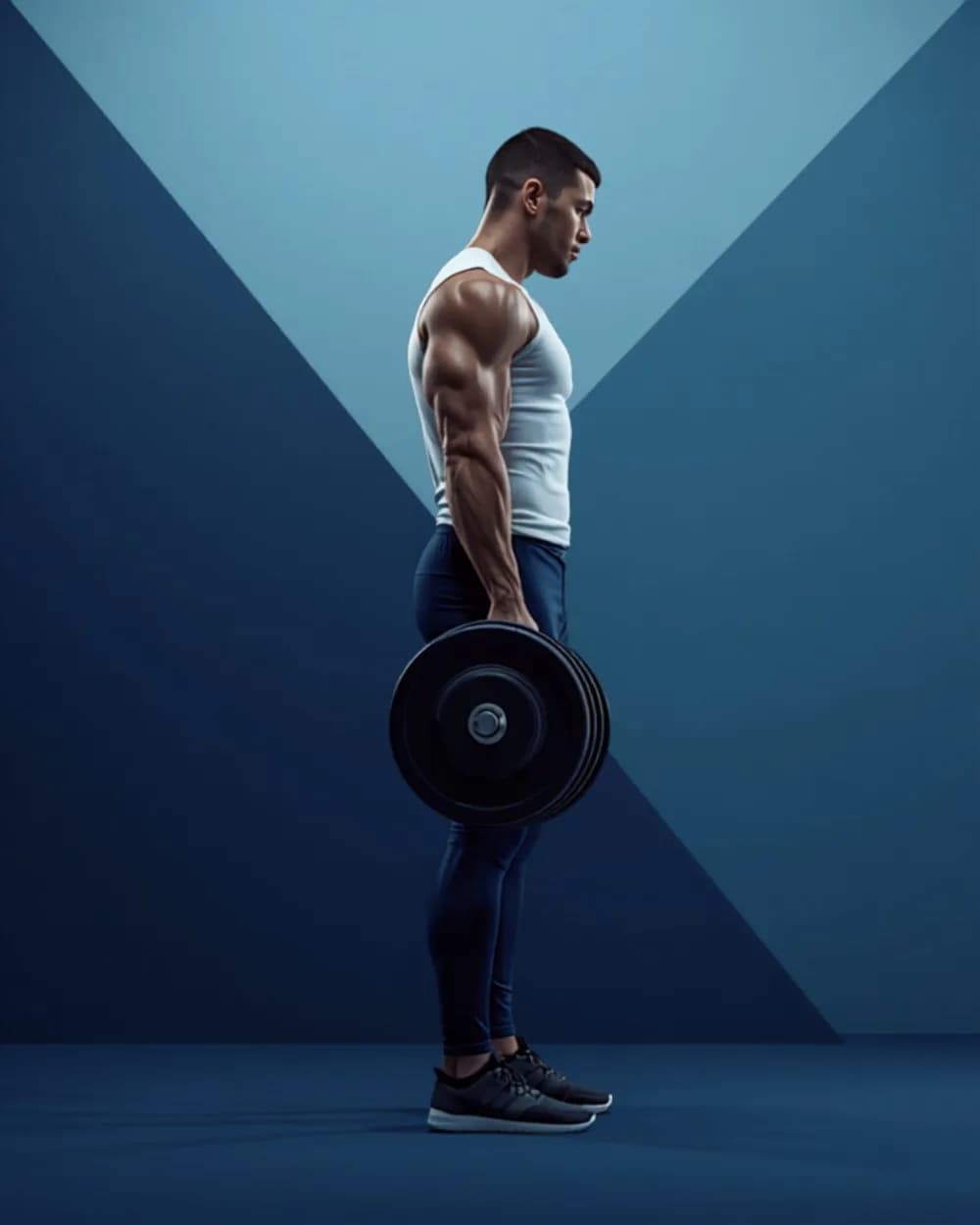
Hinge · Intermediate
Deadlift
Barbell · AI visualisation, illustrative only
- Equipment
- Barbell
- Level
- Intermediate
- Primary muscles
- Spinal erectors, Gluteus maximus, Hamstrings
- Secondary muscles
- Lats, Quadriceps, Forearms, Traps
- Working range
- 3–6 reps · RIR 3
Step by step
- 1Set up with the bar over mid-foot. Looking down, the bar should hide your shoelaces.
- 2Feet hip-width — narrower than in a squat.
- 3Hinge at the hips and grip the bar just outside your legs, arms straight.
- 4Bend your knees until your shins touch the bar. The bar must not drift forward as you do it.
- 5Set your back as if squeezing an orange under each armpit. Chest up, hips below shoulders but above knees.
- 6Take a breath, brace and push the floor away — the bar travels up along your legs.
- 7Once past the knees, finish with your hips. You end standing tall, not leaning back.
- 8Lower the same way: hips back first, then knees.
What makes the biggest difference
- Bar over mid-foot throughout — this is the one thing to guard above all.
- Brace before you grip the bar, not while pulling.
- Reset every rep: put the bar down, check your position, then pull.
Common mistakes
The bar drifts away from the legs
Every centimetre away multiplies the load on your lower back. Engage your lats and pull the bar into you before it leaves the floor.
Rounded back at the start
Usually the bar is too far away or the hips are too low. Fix the setup instead of fighting the weight — a rounded lumbar spine raises injury risk sharply.
Leaning back at the top
It adds nothing to the lift and heavily loads the facet joints. Finish standing upright with the glutes squeezed.
Dropping the weight down
You lose half the stimulus and risk injury picking up the next rep from a messy position. Take two seconds to lower.
What to do instead
Lower back pain
Trains hip extension and the glutes without loading the spine in flexion.
Limited mobility — you cannot reach the bar with a flat back
Rack pull / elevated deadlift
Raising the bar 10-15 cm shortens the range to where you can hold a neutral back. Lower the blocks over time.
Grip fails before the legs do
Deadlift with straps
Straps let you load the legs and back to their actual capacity. Train grip separately, for example with farmer’s walks.
Contraindications
- Acute disc problems or sciatica — skip it entirely until you have been assessed.
- Abdominal or inguinal hernia — the rise in intra-abdominal pressure can worsen it.
- Uncontrolled hypertension or an aneurysm — talk to a doctor before starting.
This is not medical advice. If any of these apply to you, or the exercise causes pain, talk to a doctor or physiotherapist before returning to training.
Similar exercises
Log your sets and watch the progression
You enter weight, reps and RIR — the app computes your estimated 1RM, plots the strength curve and suggests the next session’s load along with the reasoning.
Sign-ups coming soon