Hinge
Romanian deadlift
The posterior chain lift: hamstrings and glutes. Teaches you to bend at the hips instead of the back — the most useful pattern you can own.
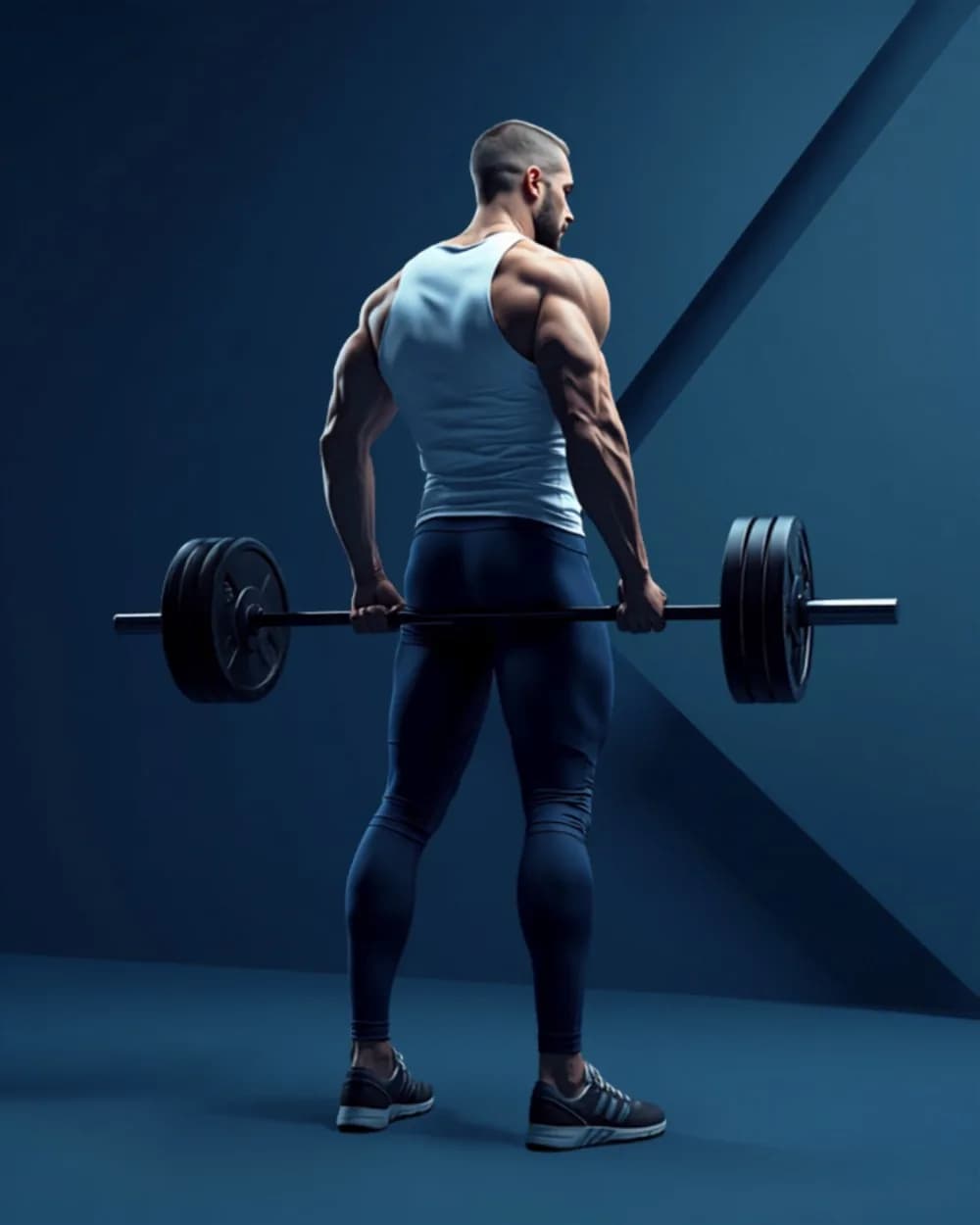
Hinge · Beginner
Romanian deadlift
Barbell · Dumbbells · AI visualisation, illustrative only
- Equipment
- Barbell, Dumbbells
- Level
- Beginner
- Primary muscles
- Hamstrings, Gluteus maximus
- Secondary muscles
- Spinal erectors, Lats
- Working range
- 6–12 reps · RIR 2
Step by step
- 1Stand holding the bar with straight arms, feet hip-width.
- 2Bend your knees slightly and lock that angle — they neither straighten nor bend further for the whole rep.
- 3Push your hips back, letting the bar slide down along your thighs.
- 4Go until you feel a strong stretch in the back of your thighs while the back stays flat. For most people that is around knee height.
- 5Come back by squeezing the glutes and driving the hips forward.
What makes the biggest difference
- This is a loaded-stretch exercise, not a max-weight lift. Lighter and deeper works better.
- Range is decided by the stretch you feel, not by how close the bar gets to the floor.
Common mistakes
Bending the knees instead of the hips
The lift turns into a squat and the posterior chain stops working. Stand near a wall and hinge until your glutes touch it.
Going too low at the cost of the back
The range ends where hamstring flexibility ends — beyond that the spine flexes. A shorter range with a flat back is better.
The bar drifts away from the legs
Keep the bar brushing your legs. The further from the hips, the more load on the lower back.
What to do instead
Lower back pain
Lying leg curl
Isolates the hamstrings with no spinal involvement. You lose the hinge pattern, but the muscle still works.
No barbell available
Dumbbell Romanian deadlift
Same movement, easier to set up, and it allows single-leg work if you have a side-to-side difference.
Contraindications
- A recent hamstring strain — loaded stretching will delay healing.
- Acute pain radiating down the leg — get it assessed before training.
This is not medical advice. If any of these apply to you, or the exercise causes pain, talk to a doctor or physiotherapist before returning to training.
Similar exercises
Log your sets and watch the progression
You enter weight, reps and RIR — the app computes your estimated 1RM, plots the strength curve and suggests the next session’s load along with the reasoning.
Sign-ups coming soon